
In this article
Search is changing fast. Generative Engine Optimization for AI search is getting common now.
People are no longer only checking Google results. They are asking ChatGPT, Perplexity, Gemini, Claude, and Google AI Overviews to compare brands, suggest products, and explain what to choose.
That creates a new challenge for SEO teams, founders, and marketing heads. Ranking on Google is still important, but it may not be enough if your brand is missing from AI-generated answers.
Generative Engine Optimization, or GEO, helps brands improve their visibility in AI search. It focuses on how AI tools find, understand, cite, and recommend businesses, products, and content.
The problem is simple. AI search does not always evaluate every brand deeply. Many times, it builds answers from the sources it can find, cite, and trust.
So a brand with more mentions, reviews, Reddit discussions, and third-party references may get more visibility than a better product with weaker online presence.
This guide explains how GEO works, how it connects with SEO, why Reddit and brand mentions matter, and how small and medium brands can improve their chances of appearing in AI search results.
You will also learn how AI search recommends brands, where its limitations are, and what practical steps businesses can take to build visibility without using spam or shortcuts.
What Is Generative Engine Optimization?
Generative Engine Optimization is the process of improving how your brand, product, or content appears in AI-generated answers.
In traditional SEO, the main goal is to rank a page on search engines like Google Search or Bing.
In GEO, the goal is to make your brand easier for AI tools to find, understand, trust, and mention in relevant answers.
For example, a user may ask:
- “What is the best CRM for a small sales team?”
- “Which accounting software is better for freelancers?”
- “Best project management tools for remote teams”
- “Top skincare brands for sensitive skin”
- “Best insurance companies for small businesses”
- “Which HR software is good for startups?”
In Google search, the user may see a list of pages.
In AI search, the user may get a direct answer with a few brand names, short comparisons, and source links.
That means your brand does not only need to rank. It also needs to be included in the answer.
Simple Definition of GEO
Generative Engine Optimization means making your brand and content easier for AI search tools to find, understand, trust, and cite.
It includes SEO, but it goes beyond your own website.
GEO also depends on how your brand is discussed across the web. This includes review sites, Reddit, forums, comparison pages, YouTube, social platforms, and third-party articles.
A simple way to understand it:
SEO helps your pages rank. GEO helps your brand appear in AI answers.
Both are connected. A page that performs well in SEO can also support GEO. But GEO also needs stronger brand signals outside your own website.
Some marketers also call this AI search optimization, AI SEO, answer engine optimization, AEO, or LLM optimization. The names are different, but the goal is similar: make your brand easier to discover in AI-powered search experiences.
The term GEO also has a research background. The original paper, GEO: Generative Engine Optimization, introduced GEO as a way to improve content visibility in generative engine responses.
How GEO Is Different from Traditional SEO
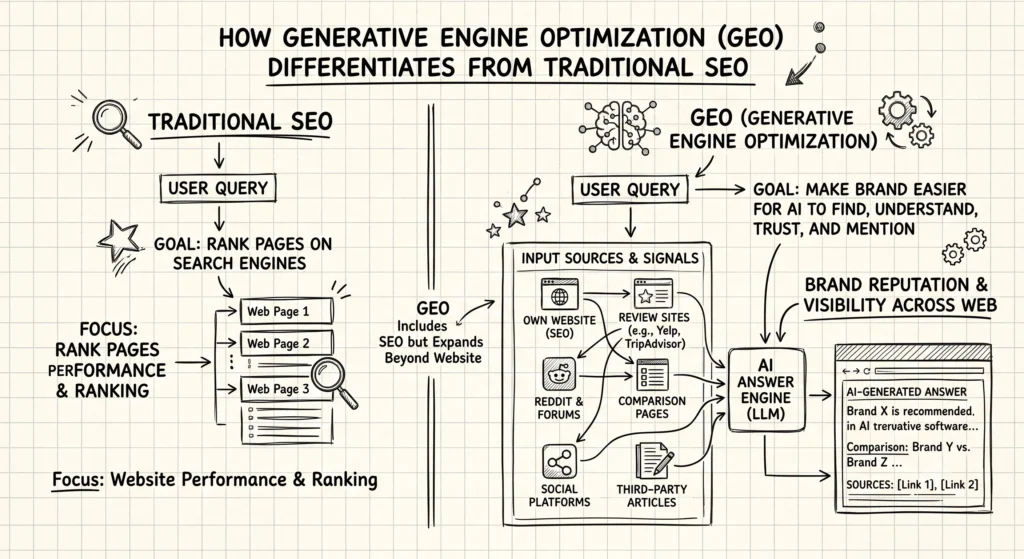
Traditional SEO is mostly page-based.
You choose a keyword, create useful content, optimize the page, build internal links, improve technical SEO, and try to rank higher in search results.
GEO is more brand and entity-based.
AI tools may look at your page, but they may also check what others say about your brand. They may use third-party articles, reviews, Reddit threads, comparison pages, and other trusted sources.
Here is the simple difference:
| Area | SEO | GEO |
| Main goal | Rank in search results | Appear in AI answers |
| Main focus | Pages and keywords | Brand, topic, and citations |
| Key signals | Content, links, technical SEO | Content, mentions, sources, trust |
| Result format | List of pages | Direct answer with citations |
| User action | Click a result | Read, compare, and decide faster |
SEO is not dead. It is still the base.
But GEO adds a new layer. Now your content must be clear enough for users, search engines, and AI answer tools.
Why GEO Matters for SEO Teams and Brands
AI search is changing how people discover products and services.
Earlier, users searched a keyword, opened multiple tabs, read a few pages, and compared options.
Now, many users ask AI tools to do the first round of research.
They ask:
- “Which tool should I use?”
- “What are the top options?”
- “Which brand is better?”
- “What are the pros and cons?”
- “Which product is best for my use case?”
If your brand is not part of that answer, you may lose visibility before the user even reaches your website.
This is why GEO matters for SEO teams, SaaS companies, service businesses, local brands, agencies, product companies, and growing startups.
It helps your brand stay visible where users now ask questions.
Why AI Search Visibility Matters for SEO Teams and Brands
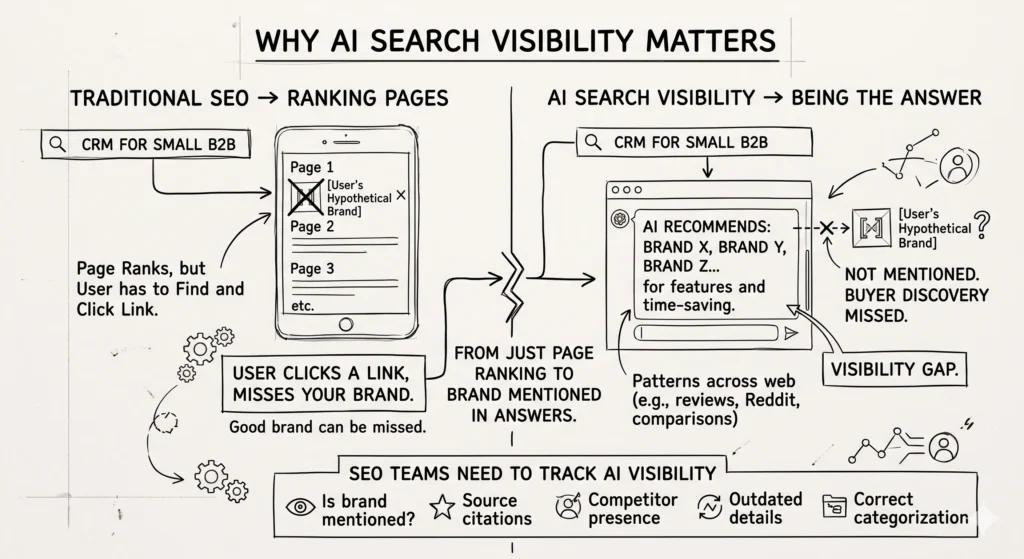
AI search visibility matters because users are becoming more dependent on direct answers.
They do not always want ten links. Many want a short answer, comparison, or recommendation.
This is especially true for business users. They want to save time and reduce confusion.
For example, a marketing head may ask:
“Which CRM is better for a small B2B sales team?”
An AI answer may mention three or four products. If your product is not included, the buyer may never discover you.
This does not mean traditional SEO has no value.
It means your SEO strategy must now support both search ranking and AI visibility.
Google also says that optimizing for generative AI features is still connected to the search experience and SEO. Its AI optimization guide explains that many normal SEO practices still matter for AI Overviews and AI Mode.
From Ranking Pages to Being Mentioned in Answers
In SEO, a user may find your page if it ranks in the top results.
In AI search, your page is not the only goal. Your brand also needs to be part of the answer.
For example, a page may rank for “best accounting software for freelancers,” but AI may still mention another brand if that brand appears across more review pages, Reddit threads, and comparison articles.
This is an important shift.
The page matters. But the brand’s overall presence also matters.
AI tools may look for patterns across the web. If many trusted sources connect your brand with a specific topic, your chances of appearing may improve.
Why Good Brands Can Still Be Missed
A good product does not automatically appear in AI answers.
This is one of the biggest pain points for small and medium brands.
A product may have strong features, good support, and loyal customers. But if there are not enough public mentions, reviews, guides, or comparisons, AI tools may not have enough evidence to recommend it.
This can create a visibility gap.
An average product with many mentions may appear more often than a stronger product with weak online presence.
This does not mean AI search is always wrong. It means AI search depends on available information.
If your brand is not visible in the right places, AI tools may not understand your value clearly.
Why SEO Teams Need to Track AI Search Results
SEO teams already track Google rankings, clicks, impressions, and backlinks.
Now they also need to track AI visibility.
This means checking whether your brand appears in answers from tools like ChatGPT, Perplexity, Gemini, Claude, AI Overviews, and other AI search systems.
You should track questions like:
- Is our brand mentioned?
- Are competitors mentioned more often?
- Which sources are being cited?
- Is our positioning correct?
- Are outdated details appearing?
- Are users seeing the right product category?
- Are comparison answers fair and accurate?
This matters because AI search can shape user opinion before the user visits your website.
How AI Search Works Differently from Google Search
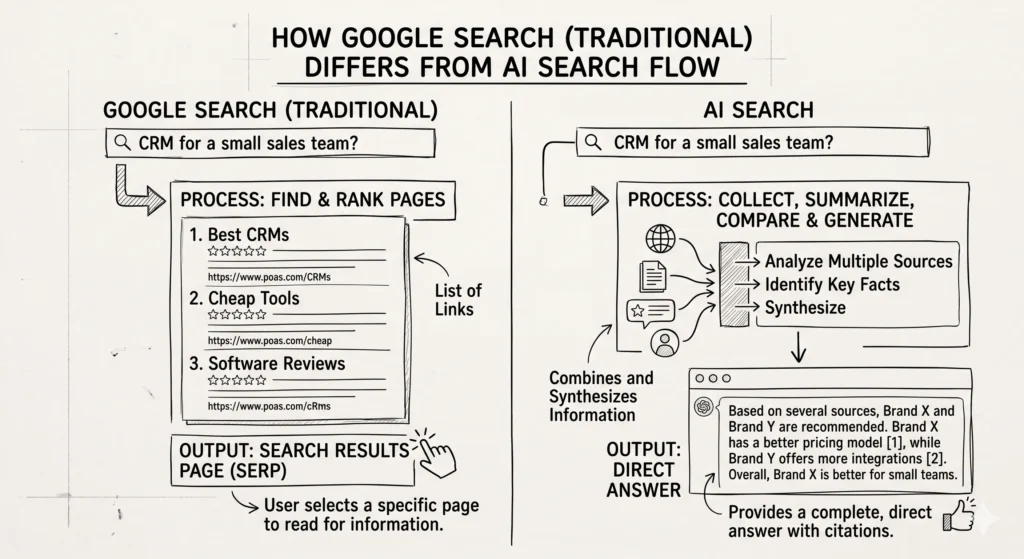
AI search tools do not work exactly like traditional search engines.
A normal search engine shows a list of ranked pages. AI search may collect information, summarize it, compare options, and give a direct answer.
The process can vary by tool, but the basic idea is simple.
AI search tries to understand the question, find useful sources, extract relevant information, and create an answer that feels complete.
This is why GEO is not only about keywords. It is about clarity, trust, sources, and context.
How AI Tools Find and Summarize Information
When a user asks a question, an AI search tool may check online sources or use its available knowledge.
It may look at pages that already rank well, trusted domains, review sites, documentation, articles, forums, Reddit threads, and other public content.
Then it summarizes the information into a direct answer.
For business and product queries, the answer may include:
- Brand names
- Product features
- Pros and cons
- Pricing notes
- Use cases
- Alternatives
- Citations
- Short recommendations
This is why your content must be easy to understand.
If your page is unclear, outdated, or filled with vague marketing lines, AI tools may not use it properly.
How Citations and Sources Shape AI Answers
Citations play a major role in many AI search results.
A citation is not just a reference. It can shape what the answer includes.
If a product is mentioned in multiple strong sources, AI tools may have more confidence that the product is relevant for that query.
For example, if many articles mention a CRM as a good option for “small sales teams,” AI search may include it when answering that type of query.
But there is a limitation.
A cited source does not always mean the AI has fully tested or deeply evaluated the product.
AI may be summarizing what is available across sources. So the quality of available information can strongly affect the final answer.
Why AI Search May Recommend a Brand or Product
AI search may recommend a brand when it finds enough signals that connect the brand with the user’s query.
These signals may include:
- Strong product pages
- Helpful guides
- Comparison articles
- Review pages
- Reddit discussions
- Forum mentions
- Expert recommendations
- Case studies
- Documentation
- Clear feature explanations
- Existing Google rankings
For example, if a user asks for “best HR software for a startup,” AI may look for brands that are repeatedly mentioned in HR software content.
It may also check whether those brands have strong product pages, reviews, comparison articles, user discussions, and trusted third-party references.
This is why GEO works only when your website, third-party mentions, reviews, and product positioning support the same story.
Should You Optimize for SEO, GEO, or Both?
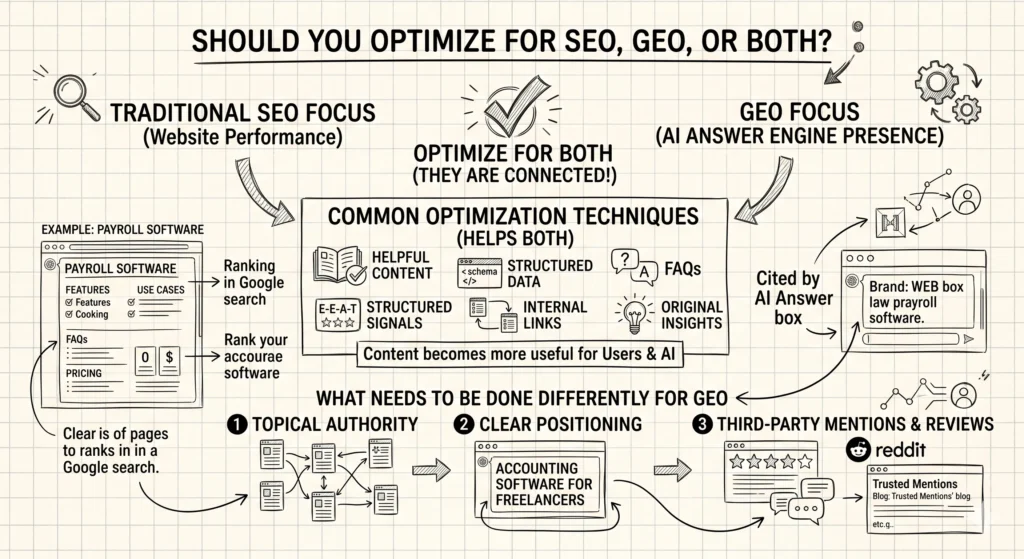
You should optimize for both.
SEO and GEO are not separate worlds. Most good SEO practices also help GEO.
A helpful page, clear structure, strong expertise, updated content, and good technical SEO can support both Google ranking and AI search visibility.
But GEO also needs something extra.
It needs brand-level signals.
For SEO, one strong page can rank for a keyword.
For GEO, AI tools may also check how your brand is described across the web. This includes third-party sites, Reddit, reviews, comparison pages, and trusted mentions.
Optimization Techniques Common to SEO and GEO
Many SEO techniques also help with GEO.
That is useful for SEO teams because they do not need to throw away their existing work.
They need to improve it so the content becomes more useful for both users and AI search tools.
Common techniques include:
| Technique | Why it helps SEO | Why it helps GEO |
| Helpful content | Improves ranking potential | Gives AI better answers to extract |
| Clear headings | Helps users and crawlers | Helps AI understand page sections |
| E-E-A-T signals | Builds trust | Shows experience and authority |
| Structured data | Helps search engines understand content | Supports clearer entity signals |
| FAQs | Targets long-tail queries | Gives AI direct answers |
| Internal links | Builds topic clusters | Shows relationship between topics |
| Updated content | Improves freshness | Reduces outdated AI answers |
| Original insights | Builds authority | Makes content more citation-worthy |
For example, a payroll software page with clear features, use cases, FAQs, pricing details, integrations, and documentation can help SEO and GEO at the same time.
The same page can rank in Google, support AI Overviews, and help AI tools understand the product better.
What Needs to Be Done Differently for GEO
GEO needs more than on-page SEO.
You must also make your brand easier to understand across the web.
This includes:
- Getting mentioned on trusted third-party sites
- Building real reviews and user feedback
- Creating comparison and alternative pages
- Being present in community discussions
- Improving product documentation
- Publishing original data or use cases
- Keeping brand and product names consistent
- Explaining who your product is best for
- Showing clear examples and proof
For example, if your company sells accounting software for freelancers, your website should explain that clearly.
But third-party pages should also connect your brand with terms like freelance accounting, invoice management, tax reports, expense tracking, payment reminders, and simple bookkeeping.
That helps AI tools understand your product category and use case.
Key Factors That Help Brands Rank in AI Search
There is no single public formula for ranking in AI search.
Different platforms work differently. ChatGPT, Perplexity, Gemini, Claude, Bing, and AI Overviews may not use the same sources or ranking logic.
Still, many common factors can improve AI search visibility.
The main goal is to build enough clear and trusted evidence around your brand.
Strong Topical Authority
Topical authority means your website covers a topic deeply and consistently.
If your brand wants to appear for “best project management software for agencies,” one article is not enough.
You may need content around:
- Project planning
- Task assignment
- Client approvals
- Time tracking
- Team workload
- Project reports
- Remote team collaboration
- Budget tracking
- Client communication
- Agency workflow examples
This helps users and search engines understand that your brand has depth in the topic.
It also helps AI tools connect your brand with that category.
Clear Brand and Product Positioning
AI tools need clarity.
If your product page is vague, AI may not understand when to recommend it.
Your content should clearly explain:
- What the product does
- Who it is for
- Which problem it solves
- Which industries it serves
- What makes it different
- What use cases it fits
- What limitations users should know
For example, do not only say:
“Our solution helps businesses work better.”
Say:
“Our project management software helps small agencies manage tasks, deadlines, client feedback, time tracking, and project reports from one dashboard.”
This is clearer for users. It is also easier for AI tools to understand.
Third-Party Mentions and Brand Citations
Third-party mentions are important for GEO.
Your own website will always speak positively about your product. AI search may also look for outside validation.
This can include:
- Review websites
- Industry blogs
- Comparison articles
- Partner pages
- App directories
- Case studies
- News mentions
- Reddit threads
- Forum discussions
- YouTube reviews
Ahrefs found that branded web mentions strongly correlate with AI visibility. It also reported that brand web mentions had one of the strongest correlations with AI Overview brand visibility in an earlier study.
This does not mean mentions guarantee AI visibility. But it does show why third-party presence should be part of a GEO strategy.
For example, if five trusted articles mention your product as an option for “CRM for small sales teams,” AI tools may see stronger evidence around your brand.
This does not guarantee ranking. But it can increase the chance that your brand is included in AI-generated answers.
Reviews, Comparison Pages, and Expert Sources
AI search often answers comparison-style queries.
Users ask:
- “Which is better?”
- “What are the top tools?”
- “Best alternatives to X”
- “Best product for small teams”
- “Which service is good for my budget?”
For these queries, AI tools may rely on comparison pages, review websites, and expert articles.
That means your brand should not only have product pages.
You should also create and earn visibility on content types like:
- Best tools lists
- Product comparison pages
- Alternative pages
- Use-case guides
- Review pages
- Industry expert roundups
- Customer stories
For example, a skincare brand should not only create a page for “face serum.”
It should also cover “serum for sensitive skin,” “vitamin C serum vs niacinamide serum,” “best skincare routine for dry skin,” and “how to choose a serum by skin type.”
This helps AI search understand when the brand is a good fit.
Structured Data, FAQs, and Direct Answers
Structured content helps both SEO and GEO.
AI tools work better when your content is easy to scan and extract.
Use:
- Clear H2s and H3s
- Short definitions
- FAQs
- Tables
- Step-by-step sections
- Product comparison blocks
- Feature lists
- Use-case examples
- Schema markup where relevant
For example, a FAQ like this can help:
What is Generative Engine Optimization?
Generative Engine Optimization is the process of improving how a brand, product, or page appears in AI-generated search answers.
This type of direct answer is useful for users. It is also easy for AI tools to reuse.
Role of Reddit in Generative Engine Optimization
Reddit has become important because it contains real user discussions.
Users talk about product issues, alternatives, pricing, support, features, and personal experience.
AI tools may find Reddit useful because it shows how people discuss a topic in natural language.
For many product categories, Reddit can show what users really ask before they buy.
OpenAI has also announced an OpenAI and Reddit partnership. OpenAI said it would access Reddit’s Data API, which provides real-time, structured Reddit content.
This does not mean every Reddit thread will rank or appear in AI answers. But it shows why Reddit discussions are now important for brand discovery and AI search visibility.
Why Reddit Appears in AI Search Discussions
Reddit has many active communities around software, finance, skincare, cars, travel, health, careers, legal topics, local services, and many niche interests.
People often use Reddit to ask:
- “Is this tool worth it?”
- “Which product should I choose?”
- “What is the best alternative?”
- “Has anyone used this brand?”
- “Is this service reliable?”
- “Which option is better for my situation?”
These discussions can shape how a brand is perceived online.
For GEO, Reddit matters because it can reflect real user language and real buyer concerns.
If users often mention your brand in helpful discussions, AI tools may better understand where your product fits.
How Reddit Can Influence Brand Discovery
Reddit can influence brand discovery because users often search for honest opinions before buying.
A person may search on Google:
“Best budgeting app Reddit”
Or they may ask AI:
“What do Reddit users say about this budgeting app?”
If your brand is part of those discussions, it may become more visible.
But the quality of the mention matters.
A brand that is only promoted by fake comments may lose trust. A brand that is discussed naturally, with real pros and cons, can build stronger credibility.
How Brands Should Use Reddit Without Spam
Brands should not use Reddit as a place for fake promotion.
That can damage trust quickly.
A better Reddit strategy is simple:
- Monitor relevant discussions
- Answer questions honestly
- Share useful details only when relevant
- Do not hide your brand connection
- Avoid fake reviews or fake users
- Help users compare options fairly
- Learn what problems people are discussing
- Use Reddit insights to improve your content
For example, if users keep asking whether your budgeting app supports family expense tracking, add that answer clearly to your product page and FAQ.
Reddit can help you understand user pain points. Then you can improve both your product content and GEO strategy.
How AI Search Recommends Brands and Products
AI search recommendations are based on available information.
The AI tool may not test every product. It may not open a demo, talk to support, check refund history, or verify every feature in real time.
It may build an answer from sources that are available, trusted, and relevant.
This is why online presence matters.
Why More Mentions Can Improve Visibility
If a brand is mentioned across many useful sources, AI tools may have more evidence to understand it.
For example, a fitness app may appear in:
- Health blogs
- App review websites
- Reddit discussions
- YouTube reviews
- Comparison pages
- Alternative pages
- Customer case studies
- App directories
This creates a stronger web footprint.
When a user asks for “best fitness apps for beginners,” AI tools may be more likely to include brands that have stronger mention patterns.
Again, more mentions do not always mean better quality.
But more useful and trusted mentions can improve visibility.
Why the Most-Cited Brand Is Not Always the Best Product
This is one of the main limitations of AI search.
AI tools may recommend brands based on the sources they find. That does not always mean the recommended product is the best for every user.
A product may be popular because it has:
- More PR coverage
- More review listings
- More listicle mentions
- More Reddit discussions
- More affiliate articles
- More branded searches
- More content budget
Another product may be better for a specific use case but have fewer public mentions.
In that case, AI search may not recommend it as often.
This is important for users and businesses.
Users should evaluate the product from their own side.
Businesses should not depend only on product quality. They also need visibility, proof, and clear public information.
What AI Search Recommendations Mean for Buyers
AI search is useful for discovery, but it should not be the final decision-maker.
Before choosing a product or service, buyers should still check:
- Features
- Pricing
- Support quality
- Documentation
- Reviews
- Refund policy
- Update history
- Real use cases
- Integration options
- Product limitations
For example, AI may suggest a popular accounting tool.
But a business should still check whether it supports local tax rules, invoice formats, payment reminders, bank sync, and accountant access.
AI can reduce research time. It should not replace real evaluation.
Can Brands Influence AI Search Results with GEO?
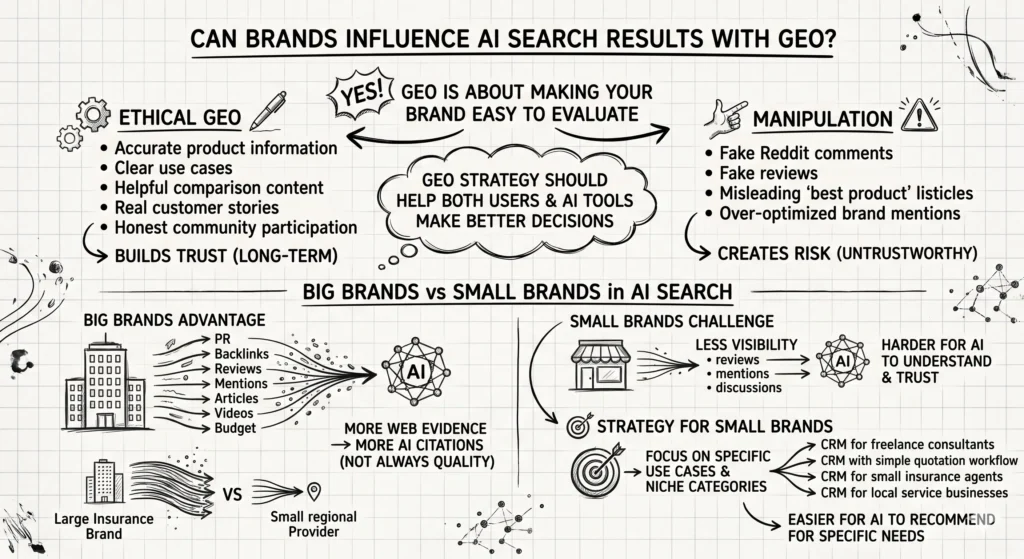
Yes, brands can influence AI search results.
But there is a difference between ethical GEO and manipulation.
Ethical GEO means improving your brand’s visibility by publishing useful content, earning real mentions, answering user questions, and making information easy to understand.
Manipulation means using fake reviews, spam comments, paid fake mentions, misleading comparison pages, or low-quality content to push a brand artificially.
The first builds trust. The second creates risk.
Ethical GEO vs Manipulation
GEO is not about tricking AI.
It is about making your brand easier to evaluate.
Good GEO includes:
- Accurate product information
- Clear use cases
- Helpful comparison content
- Real customer stories
- Honest community participation
- Expert-led content
- Updated documentation
- Transparent pros and cons
Manipulation includes:
- Fake Reddit comments
- Fake reviews
- Misleading “best product” listicles
- Doorway pages
- Low-quality mass content
- Over-optimized brand mentions
- Hidden sponsorships
- False claims about competitors
A good GEO strategy should help both users and AI tools make better decisions.
If the content only exists to push a brand, it may not build long-term trust.
How Big Brands Build More AI Visibility
Big brands often have an advantage in AI search.
They usually have more:
- PR coverage
- Backlinks
- Reviews
- Mentions
- Affiliate articles
- YouTube videos
- Reddit discussions
- Branded searches
- Comparison page mentions
- Content and marketing budget
This gives AI tools more information to find and cite.
For example, a large insurance company may appear in hundreds of “best insurance” articles. A smaller insurance provider may offer better support in a specific region but have fewer public mentions.
So AI search may mention the large brand more often.
This is not always about product quality. It is often about available web evidence.
Why Smaller Brands Face a Harder Challenge
Small and medium brands may face a harder challenge because they have less public visibility.
They may not have many reviews, comparison mentions, Reddit discussions, or media mentions.
This makes it harder for AI tools to understand and trust them.
But smaller brands can still compete.
They should not try to beat big brands everywhere. They should focus on specific use cases, long-tail queries, niche categories, and stronger proof.
For example, instead of trying to rank for “best CRM,” a smaller brand can target:
- CRM for local service businesses
- CRM for freelance consultants
- CRM for small insurance agents
- CRM for B2B distributors
- CRM with simple quotation workflow
This makes the brand easier to recommend for specific needs.
GEO Mistakes Brands Should Avoid
GEO should not become spam.
Trying to force brand mentions everywhere can harm trust.
Avoid:
- Fake community promotion
- Fake reviews
- Thin “best tools” pages
- Copied comparison content
- Misleading competitor claims
- Repeating the brand name unnaturally
- Publishing pages without real value
- Hiding sponsorships or paid placements
These tactics may create short-term visibility, but they can damage reputation.
They can also make users lose trust when they find the content is biased or fake.
A better approach is to build real proof.
Answer user questions. Publish useful comparisons. Keep product details clear. Improve your online reputation in a way that helps buyers make better decisions.
GEO Strategy for Small and Medium Brands
Small and medium brands need a focused GEO strategy.
They may not have the budget to dominate every broad keyword or every third-party platform.
So the goal should be clear.
Build trust in a niche, answer real buyer questions, and create proof that AI tools and users can understand.
Build Niche Topical Authority
Do not try to cover everything.
Choose the topics where your brand has real expertise.
For example, if your company sells HR software for small businesses, build content around hiring, employee onboarding, attendance, payroll, leave tracking, performance reviews, and compliance.
Create a full topic cluster.
This may include:
- Main guide
- Feature pages
- Use-case pages
- FAQs
- Comparison pages
- Setup guides
- Case studies
- Troubleshooting content
- Integration pages
This helps users, Google, and AI tools understand your area of expertise.
Create Comparison and Alternative Pages
AI search often answers comparison queries.
So brands should create honest comparison content.
Examples:
- Product A vs Product B
- Best alternatives to Product A
- Best tools for a specific use case
- Platform comparison for small businesses
- Service comparison by price and support
- Product comparison by features
Keep these pages fair.
Mention where your product is strong. Also mention when another option may be better.
This builds trust.
For example:
“Our tool is a better fit for small teams that need simple task tracking and client approvals. A larger enterprise platform may be better for companies that need advanced portfolio management.”
This type of honest content is better for users and better for long-term GEO.
Publish Original Research, Data, and Use Cases
Original content is very useful for GEO.
AI tools and other websites are more likely to cite content that adds something new.
You can publish:
- Industry studies
- Customer data trends
- Product usage insights
- Benchmark reports
- Survey results
- Case studies
- Real implementation examples
- Pricing comparison data
- Feature adoption reports
For example, a project management company can publish a study on how small agencies manage deadlines and client revisions.
A skincare brand can publish survey data on common skin concerns by age group or skin type.
An accounting software company can publish a report on common invoicing mistakes made by freelancers.
Original content gives others a reason to mention and cite your brand.
Get Mentioned on Trusted Third-Party Sources
Your own website is important, but third-party mentions can support GEO strongly.
Try to earn mentions from:
- Industry blogs
- Review platforms
- Software directories
- Partner websites
- Local directories
- Podcast notes
- YouTube reviews
- Expert roundups
- Case study pages
- Community discussions
Do not focus only on backlinks.
For GEO, brand mentions also matter.
A simple unlinked mention on a trusted page can still help AI tools understand that your brand is connected to a topic.
Keep Product Information Clear and Updated
AI tools may use outdated information if your product details are not clear.
Keep your important pages updated.
This includes:
- Product features
- Pricing
- Integrations
- Service areas
- FAQs
- Screenshots
- Demo details
- Documentation
- Changelog
- Support policy
- Use cases
For example, if your accounting tool now supports automatic payment reminders, update the product page, documentation, FAQs, and comparison content.
Do not assume AI tools will understand new features from one update.
Repeat important changes naturally across relevant pages.
How to Optimize Content for AI Search
AI search works best with clear, useful, and well-structured content.
Your content should answer real questions directly.
It should not hide the answer behind long intros or vague marketing lines.
The goal is to make your page easy for humans to read and easy for AI tools to understand.
Write Direct Answers for Important Questions
Use question-based sections.
For example:
What is GEO?
GEO is the process of improving how your brand appears in AI-generated answers from tools like ChatGPT, Perplexity, Gemini, Claude, and AI Overviews.
This answer is short, clear, and reusable.
You can do this across your content.
Examples:
- What is the best CRM for freelancers?
- How does accounting software help small businesses?
- What is the difference between SEO and GEO?
- How does AI search choose sources?
- Why are brand mentions important in AI search?
Direct answers improve readability and may help AI tools extract better information.
Use Tables, Examples, and Step-by-Step Sections
Tables are useful for both SEO and GEO.
They help users compare details quickly.
They also make information easier to extract.
Use tables for:
- SEO vs GEO
- Feature comparisons
- Pros and cons
- Buyer checklist
- Ranking factors
- Small brand vs big brand strategy
- Platform comparison
- Content optimization checklist
Example:
| Content Type | SEO Value | GEO Value |
| Product page | Ranks for product keywords | Helps AI understand the product |
| Comparison page | Captures high-intent users | Helps AI compare options |
| Case study | Builds trust | Shows real-world proof |
| FAQ page | Targets long-tail queries | Gives direct answers |
| Review content | Supports conversion | Builds third-party validation |
This format is easy to read and easy to reuse.
Add Real Experience and Expert Inputs
Generic content is not enough.
AI search and users both need proof.
Add real experience wherever possible.
This can include:
- Client examples
- Product screenshots
- Use-case stories
- Expert comments
- Implementation lessons
- Support team insights
- Common buyer questions
- Real limitations
- Industry-specific examples
For example, instead of saying:
“Our HR software improves business efficiency.”
Say:
“In a 40-person company, HR teams often need attendance tracking, leave approvals, payroll reports, and employee records in one place. These workflows should be planned before choosing HR software.”
This sounds more practical and trustworthy.
Make Pages Easy to Crawl, Understand, and Cite
Technical SEO still matters.
If search engines cannot crawl your page properly, AI search visibility may also suffer.
Check these basics:
- Page is indexable
- Important content is in HTML
- Page loads fast
- Internal links are clear
- Schema is used where useful
- Canonicals are correct
- Content is not hidden behind scripts
- Images have useful alt text
- Important pages are linked from topic clusters
- Pages are updated when product details change
GEO does not replace technical SEO.
A weak technical base can limit both SEO and AI search visibility.
How to Track GEO Performance
GEO tracking is still developing.
There is no single standard tool or metric that works perfectly across every AI platform.
But brands can still track useful signals manually and with available tools.
The goal is to understand whether your brand is appearing, how it is being described, and which sources are shaping the answers.
Check Brand Mentions in ChatGPT, Perplexity, Claude, and Gemini
Start with your most important buyer questions.
Ask the same questions across multiple AI tools.
Examples:
- “Best CRM for small sales teams”
- “Best accounting software for freelancers”
- “Best HR software for startups”
- “Best skincare brands for sensitive skin”
- “Best project management tools for agencies”
- “Alternatives to [competitor name]”
- “Which service is better for [use case]?”
Then track:
- Was your brand mentioned?
- Where was it placed?
- Was it recommended or only listed?
- Was the description accurate?
- Which competitors appeared?
- Which sources were cited?
- Did the answer change over time?
Do this every month.
AI answers can change based on updates, sources, and platform behavior.
Track AI Citations and Source Mentions
If an AI tool cites sources, check those sources carefully.
Ask:
- Is our page cited?
- Are competitor pages cited?
- Are review sites cited?
- Are Reddit threads cited?
- Are outdated articles being used?
- Is the cited page accurate?
- Does the cited page mention our brand?
This helps you understand the source gap.
For example, if AI keeps citing a “best tools” article that does not include your product, that article may be important for outreach.
If AI cites Reddit threads with wrong information, you may need better public documentation and honest community answers.
Compare AI Visibility with Google Rankings
Do not track GEO separately from SEO.
Compare both.
A simple tracking sheet can include:
| Query | Google Ranking | AI Mention | AI Citation | Competitors Mentioned | Action Needed |
| Best CRM for freelancers | Page 1 | Not mentioned | Review article | Larger CRM brands | Improve third-party mentions |
| HR software for startups | Top 5 | Mentioned | Product page | Two SaaS tools | Improve comparison content |
| Accounting software for small business | Page 2 | Not mentioned | Directory listing | Established brands | Build use-case content |
This makes GEO practical.
You can see where SEO is strong but AI visibility is weak.
You can also find where third-party mentions are missing.
What AI Search Recommendations Mean for Users
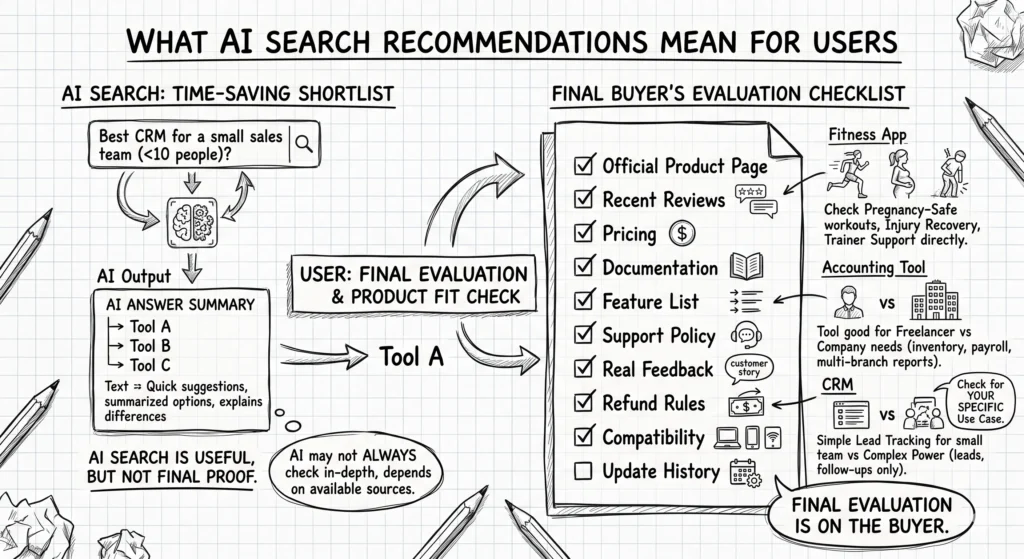
GEO is mainly a business strategy, but it also matters for users.
AI search can help users save time. It can summarize options, explain differences, and suggest products quickly.
But users should still evaluate the final choice themselves.
AI search may not always check every product in depth.
It may depend on available sources, citations, reviews, and public mentions.
AI Search Is Useful, But It Is Not Final Proof
AI search is good for early research.
It can help users shortlist options.
But before buying, users should still check:
- Official product page
- Recent reviews
- Pricing
- Documentation
- Feature list
- Support policy
- Real customer feedback
- Refund rules
- Compatibility
- Update history
For example, AI may recommend a popular fitness app.
But if you need pregnancy-safe workouts, injury recovery plans, meal tracking, or trainer support, you should check those details directly.
AI can guide the research. The final evaluation should still be done by the buyer.
Why Users Should Check Product Fit
A product can be good and still not be right for every business or user.
For example, a simple accounting tool may be good for freelancers, but not for a company that needs inventory, payroll, and multi-branch reporting.
A popular skincare product may work well for oily skin, but not for sensitive skin.
A large CRM may be powerful, but too complex for a small team that only needs lead tracking and follow-ups.
This is why users should not only ask, “Which tool is best?”
They should ask:
“Which tool is best for my use case?”
That gives better results in both AI search and traditional search.
Practical GEO Checklist
Use this checklist to start improving AI search visibility.
Do not try to do everything in one week.
Start with the most important buyer queries and product categories.
Website and Content Checklist
- Define your main product category clearly
- Create topic clusters around important use cases
- Add FAQs with direct answers
- Use clear H2 and H3 headings
- Add comparison tables where useful
- Explain who your product is for
- Mention product limitations honestly
- Add case studies and examples
- Keep documentation updated
- Add schema markup where relevant
- Improve internal linking
- Refresh old content regularly
Brand Visibility Checklist
- Track third-party mentions
- Find missing review listings
- Reach out to relevant industry blogs
- Build partner pages
- Encourage real customer reviews
- Monitor Reddit and forums
- Fix wrong public information
- Publish original research
- Create expert-led content
- Build comparison and alternative pages
- Keep brand name and product category consistent
AI Search Tracking Checklist
- List your top buyer questions
- Search them in ChatGPT, Perplexity, Gemini, and Claude
- Track whether your brand appears
- Track competitors that appear
- Save cited sources
- Check whether your product is described correctly
- Identify missing source types
- Update pages based on gaps
- Repeat the check monthly
Final Thoughts: GEO Builds on SEO
Generative Engine Optimization is not a replacement for SEO.
It is the next layer of search visibility.
SEO helps your pages rank. GEO helps your brand appear in AI-generated answers.
Both need helpful content, clear structure, trust, topical authority, and technical quality.
But GEO also needs wider brand visibility. Your brand should be mentioned, reviewed, discussed, and explained across trusted sources.
For small and medium brands, the goal is not to beat every large company on broad keywords.
The smarter goal is to become highly visible for specific use cases where your product is genuinely strong.
Build useful content. Earn real mentions. Answer buyer questions clearly. Keep your product information updated. Show proof from real use cases.
AI search is still evolving, but one thing is clear.
Brands that are easy to understand, easy to trust, and easy to cite will have a better chance of being found in the next stage of search.